
Research
Hardware
A hands-on optical setup for BB84 quantum key distribution, showing how polarization encodes information and how eavesdropping is detected.
Read moreBeginner Software Projects
Tutorials and small coding projects that introduce superposition, measurement, entanglement, and simple algorithms on simulators and real quantum hardware.
Read moreAdvanced AI in QEC
A compact Transformer-based decoder for surface-code quantum error correction, trained on simulated syndromes and tested on hardware data.
Read moreHardware
This project explores a hands-on way to understand BB84 quantum key distribution through an analog optical setup — the Quantum Cryptography Analogy Demonstration Kit. The kit demonstrates how polarization states can encode information and how eavesdropping attempts can be detected, helping students connect core quantum communication concepts to a tangible experiment.

Research poster overview for the Quantum Cryptography Analogy Demonstration Kit.

Experimental setup used to model sender, receiver, and eavesdropper interactions.
Beginner Software Projects
This track is for members who are new to the field and want a starting foundation of quantum information. We will work through beginner Quantum tutorials and small coding projects that introduce the beginning concepts taught in every quantum information course: superposition, measurement, entanglement, and simple algorithms. This will be done on both quantum computing simulators and real quantum hardware.
Advanced AI in QEC
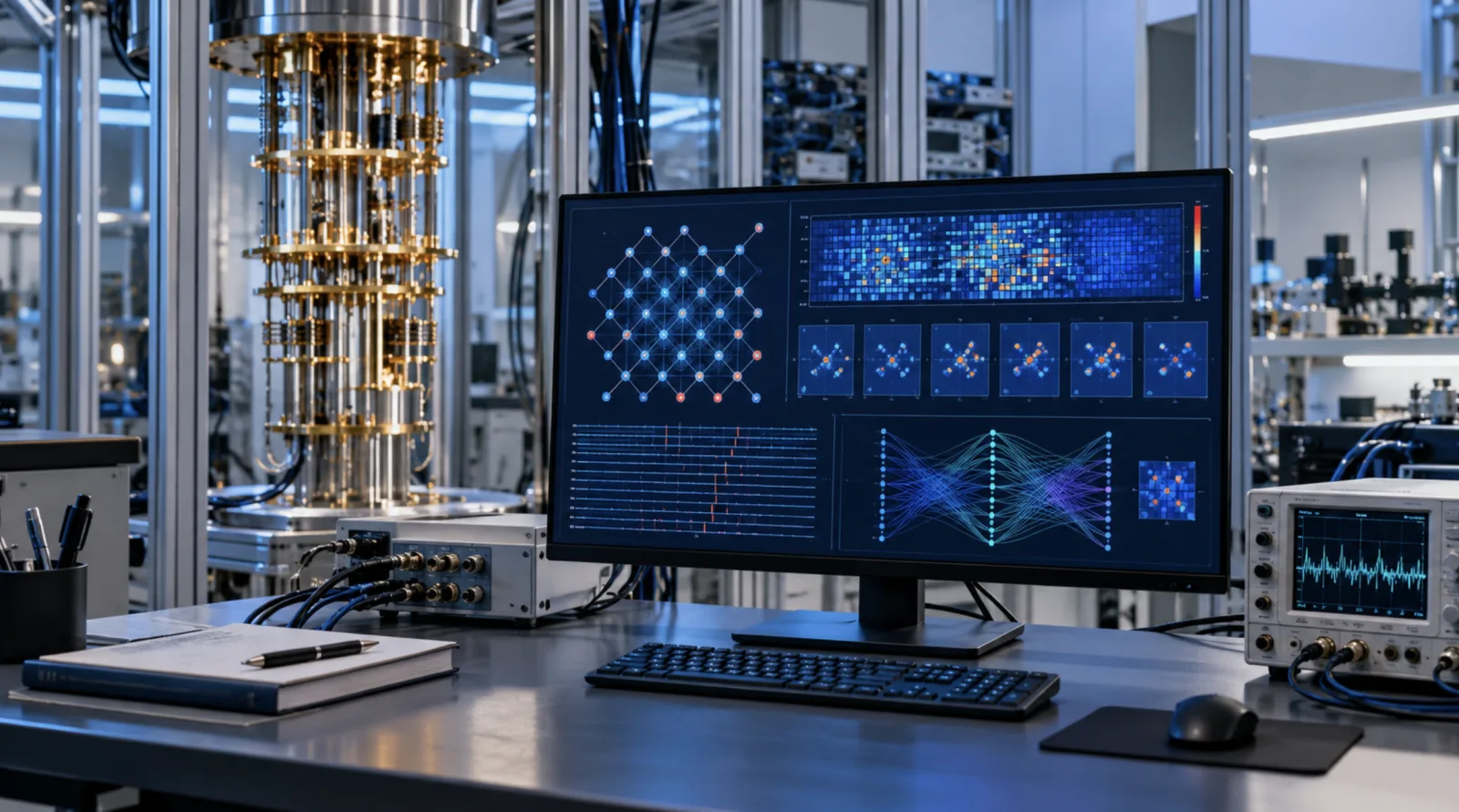
An AI generated image of our future software working alongside superconducting hardware.
Quantum computers are highly sensitive to noise and physical errors. Quantum error correction reduces the impact of these errors by extracting syndrome information and using a decoder to estimate the most likely error without directly measuring the encoded quantum state. This project proposes the development of a compact Transformer-based decoder for surface-code quantum error correction. The work extends an existing distance-3 repetition-code study into a surface-code environment using Stim.
The system will simulate repeated stabilizer measurements, generate syndrome and detection-event sequences, introduce controlled noise, and evaluate the decoder against conventional approaches such as lookup tables and minimum-weight perfect matching. The project will first train the model using approximately 1–5 million simulated syndrome sequences covering gate, measurement, single-qubit, depolarizing, and correlated noise. The model will then be tested and fine-tuned using publicly available quantum-hardware data to study the gap between simulated and real-device noise.
Performance will be evaluated using logical error rate, prediction accuracy, inference latency, model size, robustness, and generalization to noise conditions not used during training. The long-term goal is to determine whether a specialized AI decoder can complement traditional QEC methods and scale from distance-3 codes to larger distance-5 and distance-7 surface codes.